

Ask any teacher: managing challenging behavior in the classroom isn’t easy—especially when you’re just starting out. But what if the key isn’t about control, but connection?
That question inspired us to explore what happens when pre-service educators are trained in Collaborative Problem Solving® (CPS)—a compassionate, evidence-based approach to understanding and responding to challenging behavior.
At Think:Kids, we partnered with a Master of Arts in Teaching (MAT) program at a small university in the Northeast to find out: Could training in CPS better prepare student-teachers to manage behavior, build confidence, and feel more ready to lead a classroom? The results of this mixed-methods study—collected between December 2023 and May 2024—suggest the answer is yes.
Here’s what we learned, and why it matters for both new and seasoned educators.
Over 30 student-teachers received 16 hours of CPS training while completing their student-teaching in a local district. What did they take away? Practical strategies they could actually use.
“CPS gave me concrete ideas—de-escalation tactics, sentence frames, questions to ask—it wasn’t just theory,” one participant shared.
By March—just a few months into applying what they learned—28 out of 31 participants had already used CPS strategies, and 26 had facilitated a full CPS problem-solving conversation with a student. That’s a remarkable rate of adoption for new teachers navigating the real-world challenges of classrooms.
Perhaps the most powerful shift was in how these pre-service educators came to understand student behavior. Before CPS, many thought misbehavior was a choice. After CPS, more began to see it differently: not as a matter of willfulness, but as a sign that a student was struggling with the skills they needed to succeed.
This shift mattered. Those who embraced this mindset saw a boost in their confidence to manage classrooms effectively. As one student-teacher put it, “It helped me reframe student behavior and feel more prepared to respond thoughtfully instead of reacting.”
Like any training, there’s always room for growth. Student-teachers appreciated the depth of the CPS training, but some wished it were offered earlier—and in shorter, more interactive sessions. Others wanted more time to connect CPS strategies directly to the students they were working with.
These are common requests, especially among new teachers balancing coursework, lesson planning, and classroom management. The good news? These are easy adjustments that can make the training even more effective.
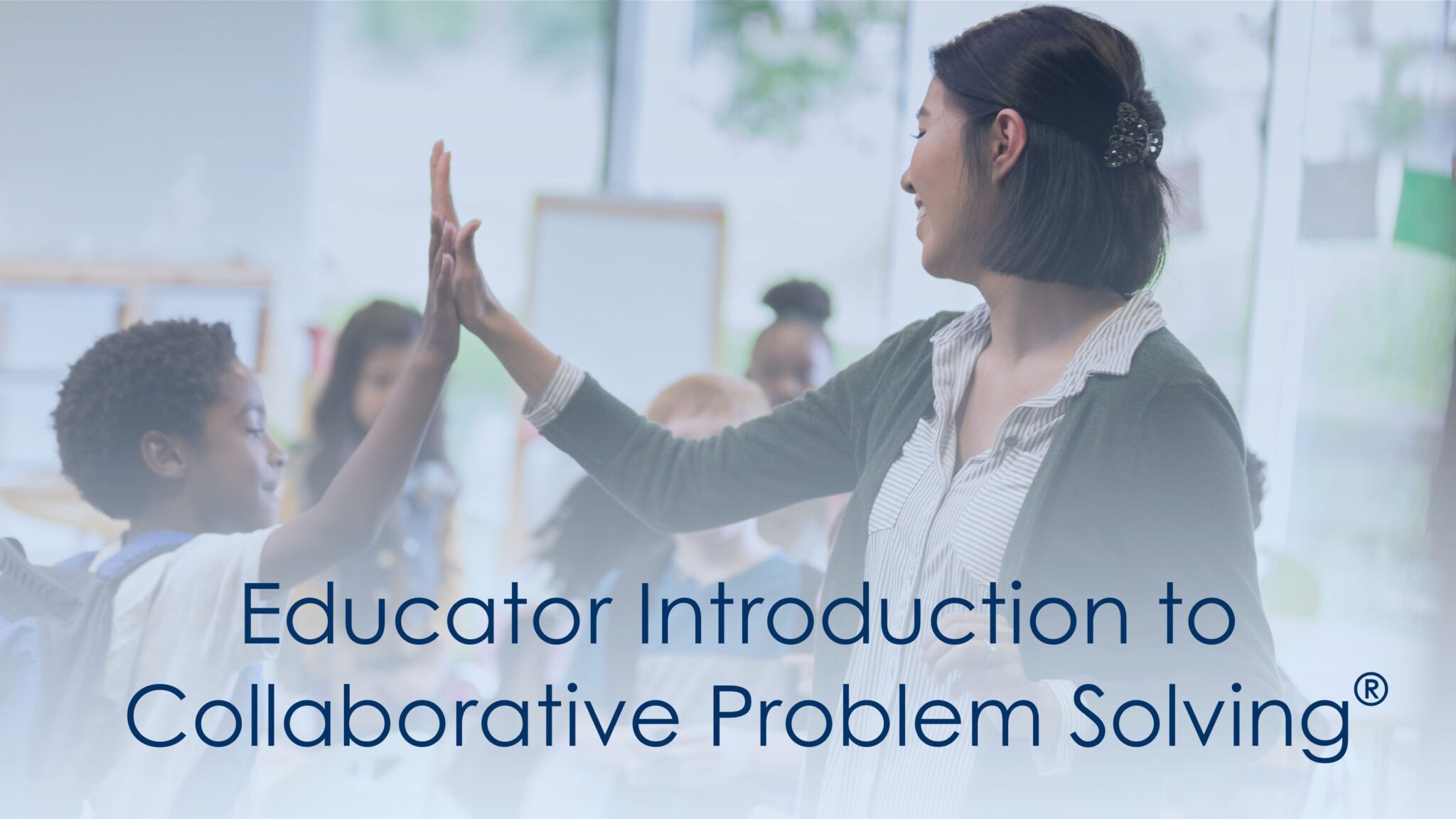
Educators, join us in this introductory course and develop your behavioral growth mindset!
This 2-hour, self-paced course introduces the principles of Collaborative Problem Solving® while outlining how the approach is uniquely suited to the needs of today's educators and students.
Tuition: $39
Enroll Now
Although this was a small study, the takeaway is clear: Collaborative Problem Solving can give future educators the tools and mindset they need to thrive.
Even without formal coaching or long-term support, most of student-teachers felt that CPS helped them grow professionally. Those who aligned more with the CPS philosophy of understanding and solving problems collaboratively—not punitively—also felt more confident managing their classrooms.
That’s worth paying attention to.
Although this study focused on pre-service teachers, many of the challenges they named—limited time and uncertainty about how to respond to student behavior—are also common among experienced educators. While we didn’t study in-service teachers in this evaluation, we would expect that the benefits of CPS—such as increased confidence and improved understanding of student behavior—would apply to current educators as well.
The early results from this small pilot suggest that when educators shift their mindset from seeing misbehavior as willful to understanding it as a signal of lagging skills, it can change how they respond—and how they feel in the classroom.
We’re excited by these initial findings and hopeful about what they mean not just for those learning to teach, but for anyone committed to doing things differently in their classroom. As schools continue to prioritize trauma-informed and relational approaches, CPS is a powerful, practical tool worth considering.
| Cookie | Duration | Description |
|---|---|---|
| __cf_bm | 1 hour | This cookie, set by Cloudflare, is used to support Cloudflare Bot Management. |
| __hssc | 1 hour | HubSpot sets this cookie to keep track of sessions and to determine if HubSpot should increment the session number and timestamps in the __hstc cookie. |
| __hssrc | session | This cookie is set by Hubspot whenever it changes the session cookie. The __hssrc cookie set to 1 indicates that the user has restarted the browser, and if the cookie does not exist, it is assumed to be a new session. |
| cookielawinfo-checkbox-advertisement | 1 year | Set by the GDPR Cookie Consent plugin, this cookie records the user consent for the cookies in the "Advertisement" category. |
| cookielawinfo-checkbox-analytics | 11 months | This cookie is set by GDPR Cookie Consent plugin. The cookie is used to store the user consent for the cookies in the category "Analytics". |
| cookielawinfo-checkbox-functional | 11 months | The cookie is set by GDPR cookie consent to record the user consent for the cookies in the category "Functional". |
| cookielawinfo-checkbox-necessary | 11 months | This cookie is set by GDPR Cookie Consent plugin. The cookies is used to store the user consent for the cookies in the category "Necessary". |
| cookielawinfo-checkbox-others | 11 months | This cookie is set by GDPR Cookie Consent plugin. The cookie is used to store the user consent for the cookies in the category "Other. |
| cookielawinfo-checkbox-performance | 11 months | This cookie is set by GDPR Cookie Consent plugin. The cookie is used to store the user consent for the cookies in the category "Performance". |
| CookieLawInfoConsent | 1 year | CookieYes sets this cookie to record the default button state of the corresponding category and the status of CCPA. It works only in coordination with the primary cookie. |
| viewed_cookie_policy | 11 months | The cookie is set by the GDPR Cookie Consent plugin and is used to store whether or not user has consented to the use of cookies. It does not store any personal data. |
| Cookie | Duration | Description |
|---|---|---|
| li_gc | 6 months | Linkedin set this cookie for storing visitor's consent regarding using cookies for non-essential purposes. |
| lidc | 1 day | LinkedIn sets the lidc cookie to facilitate data center selection. |
| UserMatchHistory | 1 month | LinkedIn sets this cookie for LinkedIn Ads ID syncing. |
| Cookie | Duration | Description |
|---|---|---|
| __hstc | 6 months | Hubspot set this main cookie for tracking visitors. It contains the domain, initial timestamp (first visit), last timestamp (last visit), current timestamp (this visit), and session number (increments for each subsequent session). |
| _ga | 1 year 1 month 4 days | Google Analytics sets this cookie to calculate visitor, session and campaign data and track site usage for the site's analytics report. The cookie stores information anonymously and assigns a randomly generated number to recognise unique visitors. |
| _ga_* | 1 year 1 month 4 days | Google Analytics sets this cookie to store and count page views. |
| _gat_gtag_UA_* | 1 minute | Google Analytics sets this cookie to store a unique user ID. |
| _gid | 1 day | Google Analytics sets this cookie to store information on how visitors use a website while also creating an analytics report of the website's performance. Some of the collected data includes the number of visitors, their source, and the pages they visit anonymously. |
| AnalyticsSyncHistory | 1 month | Linkedin set this cookie to store information about the time a sync took place with the lms_analytics cookie. |
| CONSENT | 2 years | YouTube sets this cookie via embedded YouTube videos and registers anonymous statistical data. |
| hubspotutk | 6 months | HubSpot sets this cookie to keep track of the visitors to the website. This cookie is passed to HubSpot on form submission and used when deduplicating contacts. |
| vuid | 1 year 1 month 4 days | Vimeo installs this cookie to collect tracking information by setting a unique ID to embed videos on the website. |
| Cookie | Duration | Description |
|---|---|---|
| bcookie | 1 year | LinkedIn sets this cookie from LinkedIn share buttons and ad tags to recognize browser IDs. |
| bscookie | 1 year | LinkedIn sets this cookie to store performed actions on the website. |
| li_sugr | 3 months | LinkedIn sets this cookie to collect user behaviour data to optimise the website and make advertisements on the website more relevant. |
| NID | 6 months | Google sets the cookie for advertising purposes; to limit the number of times the user sees an ad, to unwanted mute ads, and to measure the effectiveness of ads. |
| test_cookie | 15 minutes | doubleclick.net sets this cookie to determine if the user's browser supports cookies. |
| VISITOR_INFO1_LIVE | 6 months | YouTube sets this cookie to measure bandwidth, determining whether the user gets the new or old player interface. |
| YSC | session | Youtube sets this cookie to track the views of embedded videos on Youtube pages. |
| yt-remote-connected-devices | never | YouTube sets this cookie to store the user's video preferences using embedded YouTube videos. |
| yt-remote-device-id | never | YouTube sets this cookie to store the user's video preferences using embedded YouTube videos. |
| yt.innertube::nextId | never | YouTube sets this cookie to register a unique ID to store data on what videos from YouTube the user has seen. |
| yt.innertube::requests | never | YouTube sets this cookie to register a unique ID to store data on what videos from YouTube the user has seen. |
| Cookie | Duration | Description |
|---|---|---|
| __Secure-YEC | 1 year 1 month | Description is currently not available. |
| _cfuvid | session | Description is currently not available. |
| _pk_id.d014234b-506e-4c9f-8f74-9ecfcde5874f.838e | 1 hour | Description is currently not available. |
| _pk_ses.d014234b-506e-4c9f-8f74-9ecfcde5874f.838e | 1 hour | Description is currently not available. |
| cf_clearance | 1 year | Description is currently not available. |
| ppms_privacy_d014234b-506e-4c9f-8f74-9ecfcde5874f | 1 year | Description is currently not available. |
| VISITOR_PRIVACY_METADATA | 6 months | Description is currently not available. |