

When young people encounter challenging situations, escalation does not always happen immediately. Often, it builds over time as demands begin to exceed a young person’s ability to cope in that moment.
Recognizing early signs of escalation can make a significant difference. When adults are able to notice these signals sooner, they can create a greater opportunity to de-escalate situations before they reach a crisis point.
Escalation occurs in a cycle that, as described by Geoff Colvin and associates, includes seven phases: Calm, Trigger, Agitation, Acceleration, Peak, De-escalation, and Recovery. As stress increases, a young person may move from being regulated and able to think clearly to stages where their thinking skills become increasingly compromised. In the Collaborative Problem Solving® (CPS) approach, we bundle these phases into three color-coded zones of escalation that reflect different levels of intensity.
Here are some common signs to watch for:
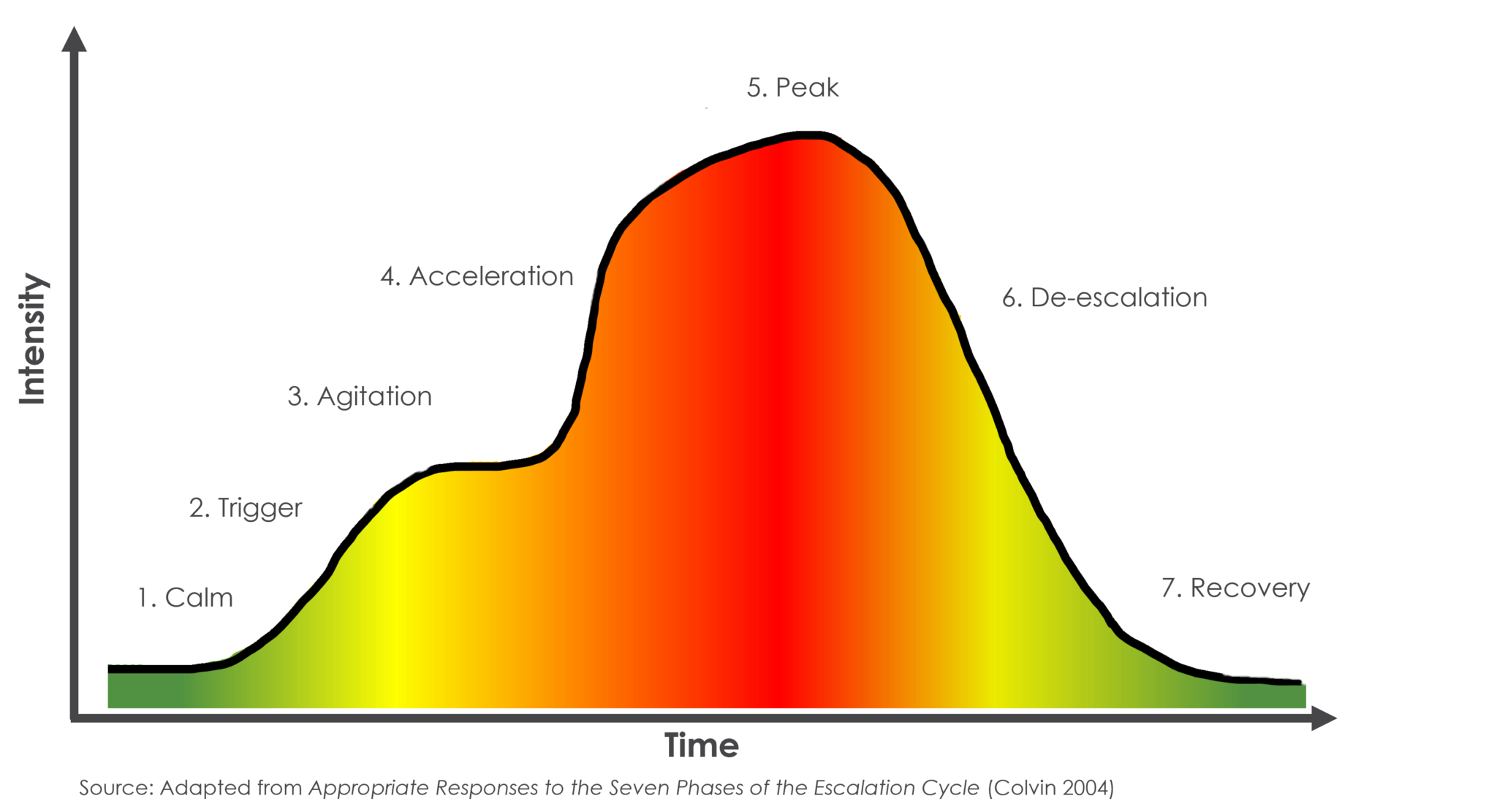
The yellow zone is where tension is building, and a young person may have difficulty accessing adaptive problem-solving skills. This is an important time for adults to take steps to increase regulation and prevent further escalation.
Signs a young person may be entering the yellow zone of escalation include:
Recognizing these signals when they first appear creates an opportunity to approach the situation with curiosity, reduce pressure when appropriate, and help the young person regain regulation.
If tension continues to build, a young person may enter the red zone of escalation, where their thinking skills are significantly compromised, and emotions may feel overwhelming, leading to an increase in concerning or unsafe behavior.
At this stage, the priority shifts to maintaining safety and supporting de-escalation.
Signs a situation may be moving into the red zone of escalation include:
During this stage, strategies that rely on reasoning or teaching are usually ineffective. Instead, adults focus on reducing stimulation, maintaining safety, and giving the young person space to regain regulation.
Recognizing the signs of escalation is one of the most effective ways to prevent challenging situations from becoming crises. While not every situation can be avoided, adults who notice changes in behavior early have more opportunities to respond in ways that reduce stress, preserve relationships, and support regulation.
The Collaborative Problem Solving approach helps adults look beyond the behavior itself to understand what may be contributing to a young person's frustration. Rather than viewing agitation or refusal as defiance, CPS encourages curiosity about the unmet expectations, unsolved problems, or lagging skills that may be driving the escalation.
As situations move through the escalation cycle, adults can adapt their responses to match the young person's ability to think and problem-solve. During calmer moments, CPS provides a structured process for identifying and solving recurring problems before they lead to future conflicts. As frustration begins to rise, adults can reduce pressure, respond with empathy, and create opportunities for the young person to regain regulation. During periods of intense escalation, the priority shifts to maintaining safety and recognizing that meaningful problem-solving can resume once the young person has recovered.
No one can eliminate every crisis, but understanding the warning signs of escalation—and responding thoughtfully throughout the escalation cycle—can help reduce the frequency and intensity of challenging situations over time. By combining early recognition with a collaborative, skill-building approach, adults can create safer environments while helping young people develop the skills they need to navigate future challenges more successfully.
The ten signs described above aren't meant to predict every crisis—they're meant to help adults recognize when a young person's stress is increasing so they can respond earlier, more effectively, and with greater confidence.
| Cookie | Duration | Description |
|---|---|---|
| __cf_bm | 1 hour | This cookie, set by Cloudflare, is used to support Cloudflare Bot Management. |
| __hssc | 1 hour | HubSpot sets this cookie to keep track of sessions and to determine if HubSpot should increment the session number and timestamps in the __hstc cookie. |
| __hssrc | session | This cookie is set by Hubspot whenever it changes the session cookie. The __hssrc cookie set to 1 indicates that the user has restarted the browser, and if the cookie does not exist, it is assumed to be a new session. |
| cookielawinfo-checkbox-advertisement | 1 year | Set by the GDPR Cookie Consent plugin, this cookie records the user consent for the cookies in the "Advertisement" category. |
| cookielawinfo-checkbox-analytics | 11 months | This cookie is set by GDPR Cookie Consent plugin. The cookie is used to store the user consent for the cookies in the category "Analytics". |
| cookielawinfo-checkbox-functional | 11 months | The cookie is set by GDPR cookie consent to record the user consent for the cookies in the category "Functional". |
| cookielawinfo-checkbox-necessary | 11 months | This cookie is set by GDPR Cookie Consent plugin. The cookies is used to store the user consent for the cookies in the category "Necessary". |
| cookielawinfo-checkbox-others | 11 months | This cookie is set by GDPR Cookie Consent plugin. The cookie is used to store the user consent for the cookies in the category "Other. |
| cookielawinfo-checkbox-performance | 11 months | This cookie is set by GDPR Cookie Consent plugin. The cookie is used to store the user consent for the cookies in the category "Performance". |
| CookieLawInfoConsent | 1 year | CookieYes sets this cookie to record the default button state of the corresponding category and the status of CCPA. It works only in coordination with the primary cookie. |
| viewed_cookie_policy | 11 months | The cookie is set by the GDPR Cookie Consent plugin and is used to store whether or not user has consented to the use of cookies. It does not store any personal data. |
| Cookie | Duration | Description |
|---|---|---|
| li_gc | 6 months | Linkedin set this cookie for storing visitor's consent regarding using cookies for non-essential purposes. |
| lidc | 1 day | LinkedIn sets the lidc cookie to facilitate data center selection. |
| UserMatchHistory | 1 month | LinkedIn sets this cookie for LinkedIn Ads ID syncing. |
| Cookie | Duration | Description |
|---|---|---|
| __hstc | 6 months | Hubspot set this main cookie for tracking visitors. It contains the domain, initial timestamp (first visit), last timestamp (last visit), current timestamp (this visit), and session number (increments for each subsequent session). |
| _ga | 1 year 1 month 4 days | Google Analytics sets this cookie to calculate visitor, session and campaign data and track site usage for the site's analytics report. The cookie stores information anonymously and assigns a randomly generated number to recognise unique visitors. |
| _ga_* | 1 year 1 month 4 days | Google Analytics sets this cookie to store and count page views. |
| _gat_gtag_UA_* | 1 minute | Google Analytics sets this cookie to store a unique user ID. |
| _gid | 1 day | Google Analytics sets this cookie to store information on how visitors use a website while also creating an analytics report of the website's performance. Some of the collected data includes the number of visitors, their source, and the pages they visit anonymously. |
| AnalyticsSyncHistory | 1 month | Linkedin set this cookie to store information about the time a sync took place with the lms_analytics cookie. |
| CONSENT | 2 years | YouTube sets this cookie via embedded YouTube videos and registers anonymous statistical data. |
| hubspotutk | 6 months | HubSpot sets this cookie to keep track of the visitors to the website. This cookie is passed to HubSpot on form submission and used when deduplicating contacts. |
| vuid | 1 year 1 month 4 days | Vimeo installs this cookie to collect tracking information by setting a unique ID to embed videos on the website. |
| Cookie | Duration | Description |
|---|---|---|
| bcookie | 1 year | LinkedIn sets this cookie from LinkedIn share buttons and ad tags to recognize browser IDs. |
| bscookie | 1 year | LinkedIn sets this cookie to store performed actions on the website. |
| li_sugr | 3 months | LinkedIn sets this cookie to collect user behaviour data to optimise the website and make advertisements on the website more relevant. |
| NID | 6 months | Google sets the cookie for advertising purposes; to limit the number of times the user sees an ad, to unwanted mute ads, and to measure the effectiveness of ads. |
| test_cookie | 15 minutes | doubleclick.net sets this cookie to determine if the user's browser supports cookies. |
| VISITOR_INFO1_LIVE | 6 months | YouTube sets this cookie to measure bandwidth, determining whether the user gets the new or old player interface. |
| YSC | session | Youtube sets this cookie to track the views of embedded videos on Youtube pages. |
| yt-remote-connected-devices | never | YouTube sets this cookie to store the user's video preferences using embedded YouTube videos. |
| yt-remote-device-id | never | YouTube sets this cookie to store the user's video preferences using embedded YouTube videos. |
| yt.innertube::nextId | never | YouTube sets this cookie to register a unique ID to store data on what videos from YouTube the user has seen. |
| yt.innertube::requests | never | YouTube sets this cookie to register a unique ID to store data on what videos from YouTube the user has seen. |
| Cookie | Duration | Description |
|---|---|---|
| __Secure-YEC | 1 year 1 month | Description is currently not available. |
| _cfuvid | session | Description is currently not available. |
| _pk_id.d014234b-506e-4c9f-8f74-9ecfcde5874f.838e | 1 hour | Description is currently not available. |
| _pk_ses.d014234b-506e-4c9f-8f74-9ecfcde5874f.838e | 1 hour | Description is currently not available. |
| cf_clearance | 1 year | Description is currently not available. |
| ppms_privacy_d014234b-506e-4c9f-8f74-9ecfcde5874f | 1 year | Description is currently not available. |
| VISITOR_PRIVACY_METADATA | 6 months | Description is currently not available. |