

Anyone who works with young people has experienced moments when tension builds, and behavior begins to escalate, sometimes to a point of crisis. In those moments that can be stressful and potentially unsafe, adults often need to respond quickly and effectively. Many traditional crisis intervention approaches focus primarily on managing behavior like this once it is already happening.
But what if we focused more on addressing the tension earlier, even before it arises? This might not be as hard as it sounds.
The Collaborative Problem Solving® (CPS) approach provides a practical framework for understanding escalation and choosing responses that help prevent and reduce crises whenever possible. One helpful way to think about this is to think about escalation as a cycle. As described by Geoff Colvin and associates, escalation occurs in a cycle that includes seven phases: Calm, Trigger, Agitation, Acceleration, Peak, De-escalation, and Recovery. These can be further categorized by colors representing the intensity of the escalation: green, yellow, and red.
Recognizing these stages can help adults adjust their responses to support safety, regulation, relationship building, and effective problem-solving.
We present Collaborative Problem Solving® as it relates to the seven commonly recognized phases of the behavioral escalation cycle (Colvin & Sugai, 1988):
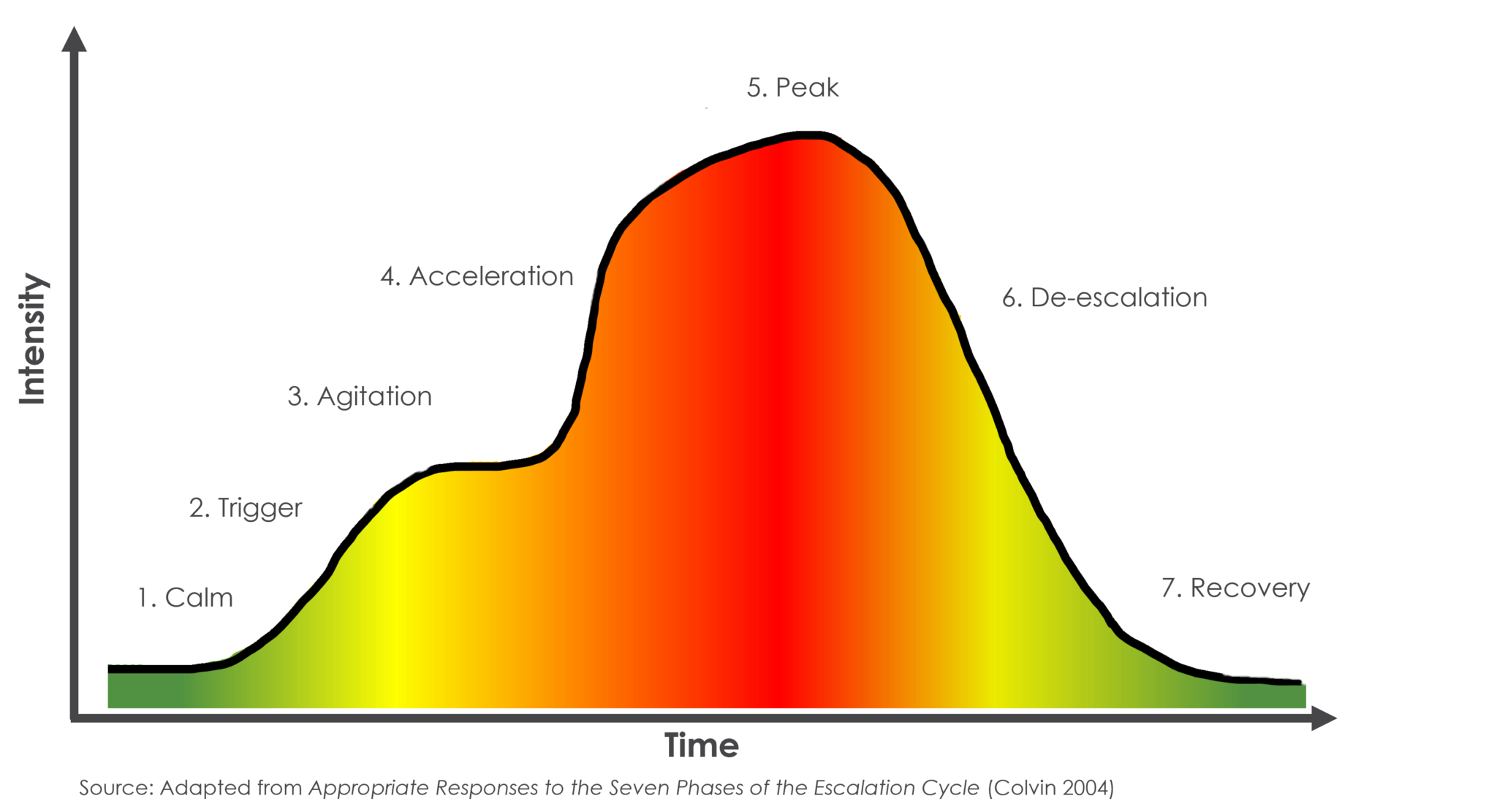
Collaborative Problem Solving can be used proactively or in the moment of a crisis to address varying degrees of escalation.
The escalation cycle considers both timing and degree of intensity. To help clarify how to effectively apply Collaborative Problem Solving across the different phases of the escalation cycle, we have categorized the phases
In the green zone of escalation, a young person tends to be in a calmer state of mind. Their cognitive skills—such as flexibility, frustration tolerance, and problem solving—are more readily available than during moments of higher escalation. Because of this, it can be an optimal time for adults to connect with youth to identify recurring challenges and collaborate to work on solving them together to reduce the likelihood that those problems will later trigger escalation.
This is the best time to focus on proactive work. This means taking time to identify what recognizable patterns of situations or difficulties tend to create tension or crisis for this youth. Then decide how you will handle those difficulties before they happen again. For example, if bedtime is difficult every night, you can come up with a plan. This might include putting an incentive into place if the youth goes to bed on time, changing the expectations of bedtime to make it a bit easier for them, or sitting down with the youth during the day to problem-solve the bedtime issues together.
The yellow zone of escalation is when stress and frustration may be increasing, and a young person’s ability to think flexibly or communicate effectively may be weakening.
At this stage, adults may begin to notice signs such as:
Recognizing this stage early creates an opportunity for de-escalation.
Rather than responding with immediate demands or assumptions about intent, adults can approach the situation with curiosity, reduce pressure when appropriate, and help the young person regain regulation. Often, thoughtful responses in this stage can prevent the situation from escalating further.
In the red zone of escalation, a young person’s thinking skills are significantly compromised. They may feel overwhelmed and unable to regulate their emotions or behavior.
At this point, the primary goal shifts from problem-solving to maintaining safety and helping the young person regain regulation.
During the red zone, strategies that rely on reasoning, teaching, or negotiation are usually ineffective because the young person’s cognitive resources are limited. Instead, adults focus on:
Once the young person has returned to a calmer state, adults can revisit the situation later to understand what led to the escalation and address the underlying problem collaboratively with the youth.
Recognizing the phases of escalation gives adults an important advantage: the ability to respond intentionally rather than reactively. But recognizing escalation is only part of the equation. Having a framework for deciding how to respond at each stage is what helps prevent situations from becoming crises whenever possible.
Collaborative Problem Solving provides that framework. Rather than viewing challenging behavior as something to control, CPS helps adults understand behavior as a signal that a young person is struggling with unmet expectations or lagging skills. This perspective shifts the focus from simply managing behavior to reducing the conditions that cause repeated crises.
CPS supports professionals across the full escalation cycle. During calmer moments, it provides a structured process for identifying and solving the problems that commonly trigger challenging behavior. As tension begins to rise, it encourages responses that reduce pressure, preserve regulation, and keep situations from escalating further. And during moments of crisis, it helps adults prioritize safety while recognizing that collaborative problem solving is most effective once the young person has regained the ability to think clearly.
By combining proactive problem solving with thoughtful responses during escalation, Collaborative Problem Solving helps create safer environments, strengthen relationships, and reduce the frequency and intensity of future crises. Rather than simply responding to challenging behavior, adults can build the skills, trust, and understanding that make those behaviors less likely to occur in the first place.
References
Colvin, Geoff. (2004). Managing the cycle of acting-out behavior in the classroom. Eugene, OR: Behavior Associates.
Colvin, G., & Scott, T. M. (2014). Managing the cycle of acting-out behavior in the classroom. Corwin Press.
Colvin, G., & Sugai, G. (1988). Proactive strategies for managing social behavior problems: An instructional approach. Education and Treatment of Children, 341-348.
| Cookie | Duration | Description |
|---|---|---|
| __cf_bm | 1 hour | This cookie, set by Cloudflare, is used to support Cloudflare Bot Management. |
| __hssc | 1 hour | HubSpot sets this cookie to keep track of sessions and to determine if HubSpot should increment the session number and timestamps in the __hstc cookie. |
| __hssrc | session | This cookie is set by Hubspot whenever it changes the session cookie. The __hssrc cookie set to 1 indicates that the user has restarted the browser, and if the cookie does not exist, it is assumed to be a new session. |
| cookielawinfo-checkbox-advertisement | 1 year | Set by the GDPR Cookie Consent plugin, this cookie records the user consent for the cookies in the "Advertisement" category. |
| cookielawinfo-checkbox-analytics | 11 months | This cookie is set by GDPR Cookie Consent plugin. The cookie is used to store the user consent for the cookies in the category "Analytics". |
| cookielawinfo-checkbox-functional | 11 months | The cookie is set by GDPR cookie consent to record the user consent for the cookies in the category "Functional". |
| cookielawinfo-checkbox-necessary | 11 months | This cookie is set by GDPR Cookie Consent plugin. The cookies is used to store the user consent for the cookies in the category "Necessary". |
| cookielawinfo-checkbox-others | 11 months | This cookie is set by GDPR Cookie Consent plugin. The cookie is used to store the user consent for the cookies in the category "Other. |
| cookielawinfo-checkbox-performance | 11 months | This cookie is set by GDPR Cookie Consent plugin. The cookie is used to store the user consent for the cookies in the category "Performance". |
| CookieLawInfoConsent | 1 year | CookieYes sets this cookie to record the default button state of the corresponding category and the status of CCPA. It works only in coordination with the primary cookie. |
| viewed_cookie_policy | 11 months | The cookie is set by the GDPR Cookie Consent plugin and is used to store whether or not user has consented to the use of cookies. It does not store any personal data. |
| Cookie | Duration | Description |
|---|---|---|
| li_gc | 6 months | Linkedin set this cookie for storing visitor's consent regarding using cookies for non-essential purposes. |
| lidc | 1 day | LinkedIn sets the lidc cookie to facilitate data center selection. |
| UserMatchHistory | 1 month | LinkedIn sets this cookie for LinkedIn Ads ID syncing. |
| Cookie | Duration | Description |
|---|---|---|
| __hstc | 6 months | Hubspot set this main cookie for tracking visitors. It contains the domain, initial timestamp (first visit), last timestamp (last visit), current timestamp (this visit), and session number (increments for each subsequent session). |
| _ga | 1 year 1 month 4 days | Google Analytics sets this cookie to calculate visitor, session and campaign data and track site usage for the site's analytics report. The cookie stores information anonymously and assigns a randomly generated number to recognise unique visitors. |
| _ga_* | 1 year 1 month 4 days | Google Analytics sets this cookie to store and count page views. |
| _gat_gtag_UA_* | 1 minute | Google Analytics sets this cookie to store a unique user ID. |
| _gid | 1 day | Google Analytics sets this cookie to store information on how visitors use a website while also creating an analytics report of the website's performance. Some of the collected data includes the number of visitors, their source, and the pages they visit anonymously. |
| AnalyticsSyncHistory | 1 month | Linkedin set this cookie to store information about the time a sync took place with the lms_analytics cookie. |
| CONSENT | 2 years | YouTube sets this cookie via embedded YouTube videos and registers anonymous statistical data. |
| hubspotutk | 6 months | HubSpot sets this cookie to keep track of the visitors to the website. This cookie is passed to HubSpot on form submission and used when deduplicating contacts. |
| vuid | 1 year 1 month 4 days | Vimeo installs this cookie to collect tracking information by setting a unique ID to embed videos on the website. |
| Cookie | Duration | Description |
|---|---|---|
| bcookie | 1 year | LinkedIn sets this cookie from LinkedIn share buttons and ad tags to recognize browser IDs. |
| bscookie | 1 year | LinkedIn sets this cookie to store performed actions on the website. |
| li_sugr | 3 months | LinkedIn sets this cookie to collect user behaviour data to optimise the website and make advertisements on the website more relevant. |
| NID | 6 months | Google sets the cookie for advertising purposes; to limit the number of times the user sees an ad, to unwanted mute ads, and to measure the effectiveness of ads. |
| test_cookie | 15 minutes | doubleclick.net sets this cookie to determine if the user's browser supports cookies. |
| VISITOR_INFO1_LIVE | 6 months | YouTube sets this cookie to measure bandwidth, determining whether the user gets the new or old player interface. |
| YSC | session | Youtube sets this cookie to track the views of embedded videos on Youtube pages. |
| yt-remote-connected-devices | never | YouTube sets this cookie to store the user's video preferences using embedded YouTube videos. |
| yt-remote-device-id | never | YouTube sets this cookie to store the user's video preferences using embedded YouTube videos. |
| yt.innertube::nextId | never | YouTube sets this cookie to register a unique ID to store data on what videos from YouTube the user has seen. |
| yt.innertube::requests | never | YouTube sets this cookie to register a unique ID to store data on what videos from YouTube the user has seen. |
| Cookie | Duration | Description |
|---|---|---|
| __Secure-YEC | 1 year 1 month | Description is currently not available. |
| _cfuvid | session | Description is currently not available. |
| _pk_id.d014234b-506e-4c9f-8f74-9ecfcde5874f.838e | 1 hour | Description is currently not available. |
| _pk_ses.d014234b-506e-4c9f-8f74-9ecfcde5874f.838e | 1 hour | Description is currently not available. |
| cf_clearance | 1 year | Description is currently not available. |
| ppms_privacy_d014234b-506e-4c9f-8f74-9ecfcde5874f | 1 year | Description is currently not available. |
| VISITOR_PRIVACY_METADATA | 6 months | Description is currently not available. |